
01 Capturing answers is not the same as understanding them
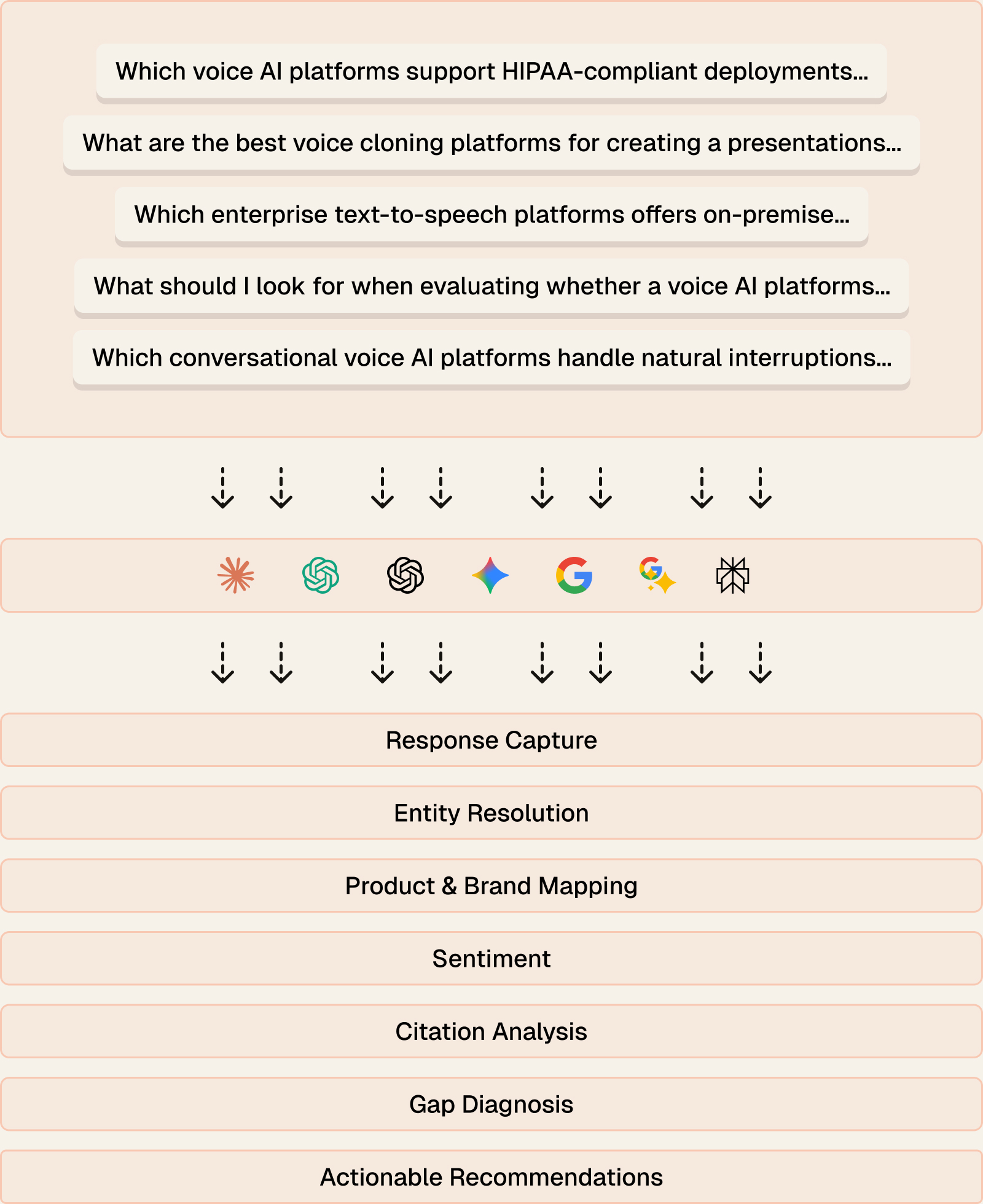
Most monitoring platforms begin with the same basic process: run prompts, collect AI responses, and track whether a brand appears.
But a comprehensive audit has to go much further.
It needs to determine:
- Which mentions refer to the same brand.
- Which products belong to which company.
- Whether sibling brands should be merged or separated.
- Whether a competitor is direct, adjacent, or only loosely related.
- Whether the sentiment is actually about the brand.
- Which cited sources are shaping the recommendation.
- Where the brand is being replaced and why.
- What the team should prioritize next.
Each layer adds more analysis, classification, computation, and quality control.
That is why monitoring platforms are usually optimized for frequency, while point-in-time audits can be optimized for depth.
Monitoring platforms are built to collect repeatedly. Audits are built to interpret thoroughly.
02 Why deeper analysis is harder to run continuously
A monitoring platform may track hundreds or thousands of prompts across many brands, regions, and engines.
Applying a full audit process to every answer, every day, would significantly increase cost and complexity.
The platform would need to repeatedly:
- Resolve entities.
- Classify products and competitors.
- Recalculate sentiment and prominence.
- Analyze citations and source influence.
- Generate diagnoses and recommendations.
- Review edge cases and classification errors.
Monitoring platforms can add some of these capabilities, but there is always a trade-off between frequency, scale, depth, and price.
This is not a criticism of monitoring. It is a difference in product design.
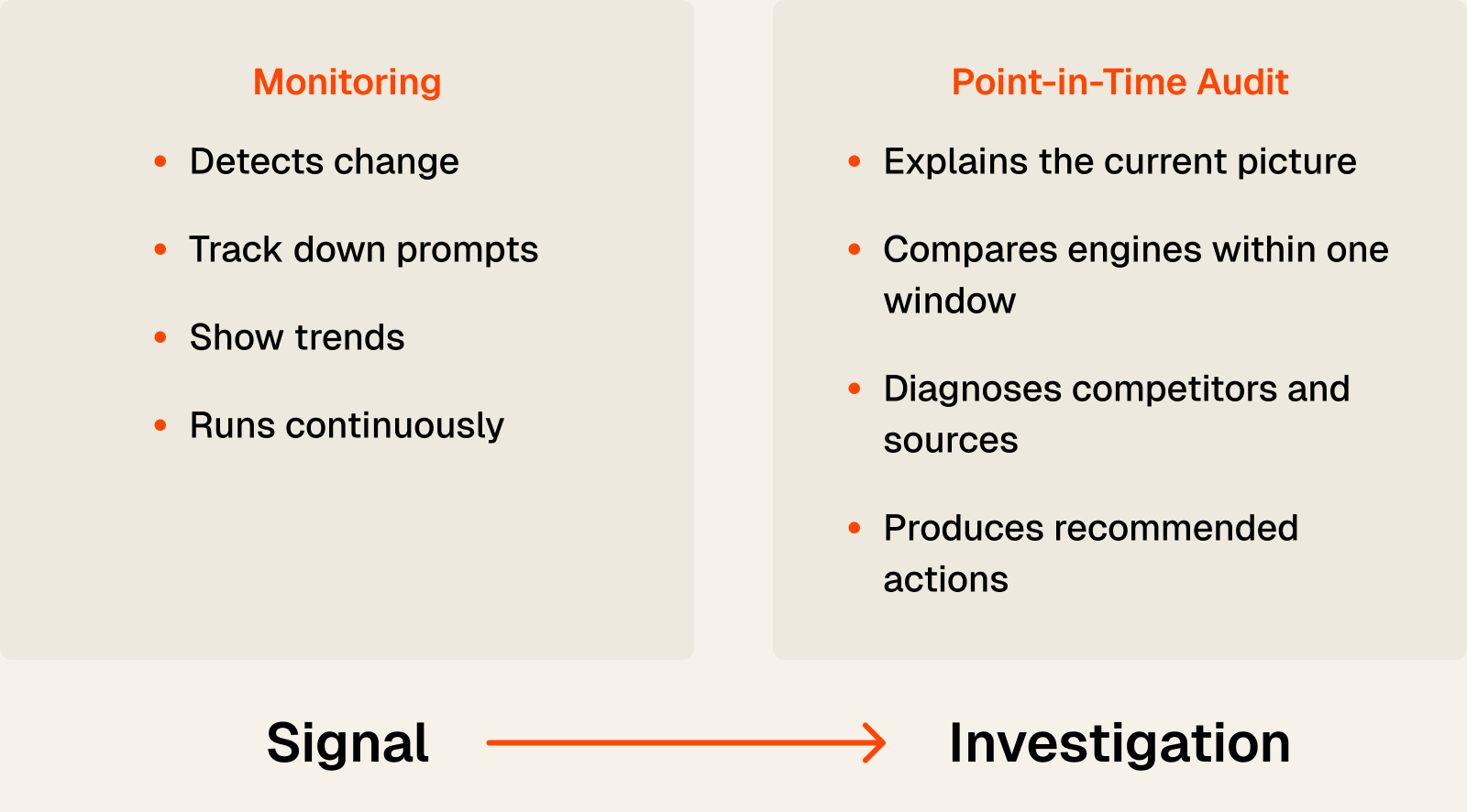
Monitoring is best when the goal is to detect movement.
A point-in-time audit is best when the goal is to understand the current market clearly enough to make a decision.
03 Rolling averages can hide the conditions behind the result
Rolling averages are useful because AI answers fluctuate.
They smooth out unusual responses and make trends easier to follow.
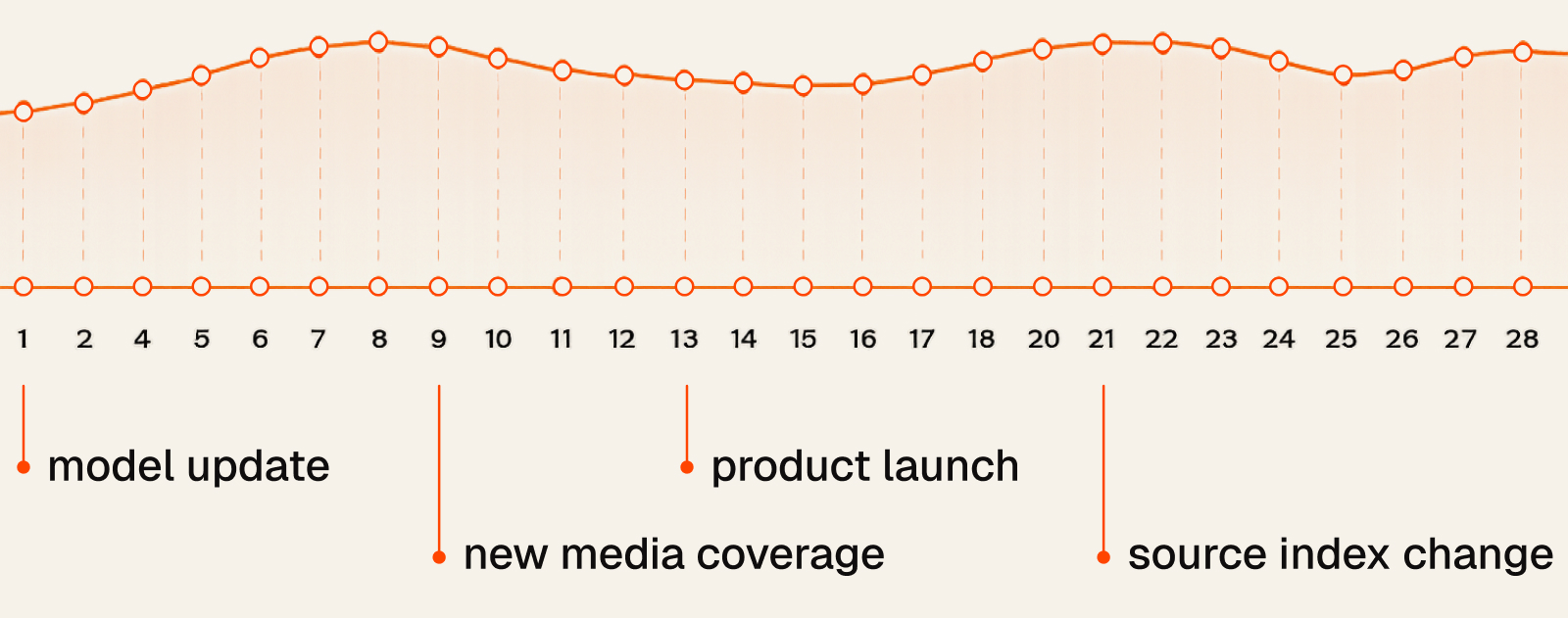
But a rolling average can also combine results gathered under different conditions:
- Before and after a model update.
- Before and after a product launch.
- Across changing source indexes.
- Before and after new media coverage.
- Across different competitive events.
- Under changing classification rules.
The average may be mathematically correct. It may still be difficult to use as a diagnosis of the current market.
For example, a 35% visibility score could mean:
- The brand stayed close to 35% all month.
- It started at 60% and recently fell to 10%.
- It dominated one engine but was absent from the others.
- It appeared often, but mostly as a secondary recommendation.
- A competitor replaced it only in the most commercially important prompts.
The number is real. The strategic meaning is still unclear.
A rolling average shows continuity. A synchronized audit provides context.
04 A synchronized audit creates a more coherent comparison
A point-in-time audit checks the same prompt set across multiple AI engines within a defined window.
It keeps the prompt scope, location, competitive context, and timing as consistent as practical.
This does not eliminate AI variability.
It makes the variability easier to compare.
If one engine recommends the brand and another recommends a competitor, the difference is less likely to be caused simply by the answers being collected weeks apart.
If the same competitor appears across several related prompts and engines during the same audit, that pattern becomes more meaningful.
If the same third-party source repeatedly supports those recommendations, the team gains a clearer picture of what is shaping the market.
A synchronized audit does not claim permanent truth. It creates a defensible picture of a defined moment.
05 Monitoring tells you something changed. An audit helps explain why.
Suppose a monitoring dashboard shows that visibility fell by eight percentage points.
That is useful.
But the team still needs to know:
- Which prompts caused the decline?
- Did it happen across all engines or only one?
- Which competitors gained the lost visibility?
- Which sources supported them?
- Was the brand absent, weakly mentioned, or framed as an inferior option?
- Is the issue related to content, positioning, third-party validation, or something else?
- What should the team act on first?
Monitoring identifies the signal.
An audit investigates the cause.
This is why the two approaches can complement each other.
A team may use monitoring to detect movement and run a deeper audit when something important changes.
Another team may only need periodic audits before a campaign, launch, client proposal, planning cycle, or market entry.
06 The real goal is not another metric
AI visibility is often reduced to a single score.
But no individual metric explains the market by itself.
A brand may have strong mention frequency but weak prominence.
It may appear often while competitors receive the actual recommendation.
It may perform well in category prompts but disappear from comparison or solution-focused questions.
It may be supported by owned content but lack independent third-party validation.
The useful question is not only:
How visible is the brand?
It is:
What is shaping that visibility, where is the brand being displaced, and what should the team do next?
That requires more than continuous collection.
It requires a coherent body of evidence, analyzed deeply enough to support a decision.
07 Monitoring is built for continuity. Auditing is built for clarity.
Monitoring has an important role.
It helps teams see movement, detect anomalies, and watch known prompts over time.
But when a team needs a baseline, a diagnosis, a competitive assessment, or a plan, it needs a synchronized view of the market.
That is the role of a point-in-time audit.
Visibl checks the same high-value prompts across seven major AI engines within a defined audit window. It then analyzes the answers as one connected body of evidence, resolving brands, products, competitors, sentiment, citations, source influence, prominence, and visibility gaps into a comprehensive report with recommended actions.
Because the goal is not simply to watch AI visibility move.
It is to understand the market clearly enough to decide what to do next.